1. Sum up Michael Wesch's main point about the web (or Youtube in particular) in one paragraph.
Michael Wesch belives that web 2.0 is about building a community within social networks and sites through videos uploaded on youtube via webcams. People can reply to other videos or make "remix's" on videos on youtube creating a culture and identity for themselves which can be commented and viewed by millions.
2. Write down your understanding of the following terms used by Wesch: "networked individualism", "the invisible audience phenomenon", "context collapse", and "connection without constraint".
Network Individualism is when an individual is lonely, they long for attention and a community. Due to the rise of communal sites sucha as youtube on web 2.0, communities are easier to build with a webcam and talk to strangers across the world.
Context collapse is not knowing when one is filmed as anybody in contemporary society can get out a smartphone and record and upload due to the advance in technology.
Invisible Audience is not knowing when or who will see a video you upload online. Like youtube videos uploaded, they will never know who will see it.
Connection without constraint ????
3. On the whole, do you agree or disagree with Wesch's ideas? Why?
Yes i agree with Weschs ideas as now through the internet, is another form of communication and houses communities with common interest. This social cohesion is created and reinforced by social network sites such as Twitter and facebook where links are shared and fan pages are created. Also on Youtube videos are made and people subscribe and reply to individuals through videos, music or animations.
4. How might Wesch's ideas be applied to the music industry (or, at least, the production of music)?
As there are millions of viewers on youtube daily, artists with a low budget can reach a broad target audience by uploading it to Youtube and as technology has increased budget microphones have decent quality anyway. This will help to promote themselves like artists such as Justin Bieber who was signed through a viewer randomly surfing the web and noticing his talent. The key benefit is that websites like youtube, facebook and twitter are free therefore have many people on those sites.
Sunday, 4 March 2012

Wednesday, 22 February 2012
Are the media becoming more democratic?
As technology advances and the world develops, the impact of this has a great effect on mass media as the way we consume media and the range of choice has expanded due to the new web 2.0. Some may argue through this evolution media itself has become more democratic, others take a more cynical perspective and argue that our human rights are being breached.
The media could be argued more democratic due to freedom of speech and the range of new technology available. Nowadays , technology has advanced so much that even the people can record, produce and share footage across the web within minutes. Whereas in the past only big media companies known as "media gods" could record and distribute media through the expensive technology and big towers. However now due to devices of digital convergance such as mobile phones makes it easy to record and share footage on the web and social sites at an affordable price known as citezen journalism. David Gauntlett argues that the media is becoming more democratic because of this and the discovery of web 2.0. This allows people to share on websites such as youtube and widens the amount of videos and opinions you can search for. Also people can check online to view media when they want rather than waiting on the traditional media like news papers or tv.
On the other hand some argue that the media is not becoming more democratic but however is becoming more hegemonic. This is due to a passive audience of the media which dominate a social context.
The media could be argued more democratic due to freedom of speech and the range of new technology available. Nowadays , technology has advanced so much that even the people can record, produce and share footage across the web within minutes. Whereas in the past only big media companies known as "media gods" could record and distribute media through the expensive technology and big towers. However now due to devices of digital convergance such as mobile phones makes it easy to record and share footage on the web and social sites at an affordable price known as citezen journalism. David Gauntlett argues that the media is becoming more democratic because of this and the discovery of web 2.0. This allows people to share on websites such as youtube and widens the amount of videos and opinions you can search for. Also people can check online to view media when they want rather than waiting on the traditional media like news papers or tv.
On the other hand some argue that the media is not becoming more democratic but however is becoming more hegemonic. This is due to a passive audience of the media which dominate a social context.
Monday, 20 February 2012
The long tail
1. What is Chris Anderson’s theory of ‘the long tail’?
The long tail refers to the statistical property that a larger share of population rests within the tail of a probability distribution.
The long tail refers to the statistical property that a larger share of population rests within the tail of a probability distribution.
 | |||
| Power law chart |
2. What does the theory of ‘the long tail’ mean for the music industry and to other areas of the media such as online television?
3. What is Don Tapscott and Anthony Williams’ theory of Wikinomics?
A term invented by Don Tapscott to refer to the theory in practice of mass collaboration.
Tuesday, 14 February 2012
Task 2 - Piracy
Is piracy killing the music industry or are there other factors for the causes of the music industry declining?
Thursday, 9 February 2012

Democracy
Whilst randomly surfing the internet and watching videos on youtube i stumbled upon this conversation which is an example of democracy on web 2.0 and even if comments are ethically wrong they still have freedom of speech.

He is also reffered to as a "troll"

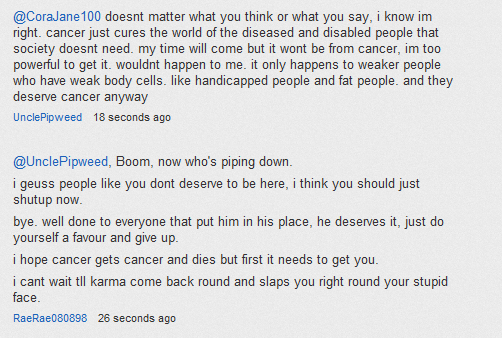
He is also reffered to as a "troll"

Monday, 6 February 2012
David Gauntlett's ideas
1. According to Gauntlett, what was "the media" like in the past and what changes have now occurred?
The media use to dominate and descend news to us like "Gods" in the heavens down to the "little people" (us). Now anybody can distribute media through citizen journalism. Before you needed big cameras and sound technology also massive distributing towers. In contemporary society smart phones are used to capture and even distribute through websites such as youtube and wikipedia. Thus using web 2.0.
2. How far do you agree with Gauntlett?
I agree strongly on David Gauntlets theory as now people search online for the latest news and look at more than 1 perspective. Also they can find it literally when and where they want. However, authors online may not have the same credibility as news corporations such as the BBC and the Guardian. Also only 20 % of all youtube viewers actually upload so that narrows down the number of perspectives drastically.
3. How might Gauntlett's ideas be applied to the music industry?
Before music good music technology was expensive but now decent equipment is cheap. therefore anybody can make and distribute music using the technology we have today and use the internet and websites such as youtube and myspace to distribute music like artists such as Lilly Allen and Justin Bieber were found on myspace and youtube and later on signed to record labels. Whereas before you had to be signed to a label to get any sort of recognition.
The media use to dominate and descend news to us like "Gods" in the heavens down to the "little people" (us). Now anybody can distribute media through citizen journalism. Before you needed big cameras and sound technology also massive distributing towers. In contemporary society smart phones are used to capture and even distribute through websites such as youtube and wikipedia. Thus using web 2.0.
2. How far do you agree with Gauntlett?
I agree strongly on David Gauntlets theory as now people search online for the latest news and look at more than 1 perspective. Also they can find it literally when and where they want. However, authors online may not have the same credibility as news corporations such as the BBC and the Guardian. Also only 20 % of all youtube viewers actually upload so that narrows down the number of perspectives drastically.
3. How might Gauntlett's ideas be applied to the music industry?
Before music good music technology was expensive but now decent equipment is cheap. therefore anybody can make and distribute music using the technology we have today and use the internet and websites such as youtube and myspace to distribute music like artists such as Lilly Allen and Justin Bieber were found on myspace and youtube and later on signed to record labels. Whereas before you had to be signed to a label to get any sort of recognition.
Subscribe to:
Posts (Atom)